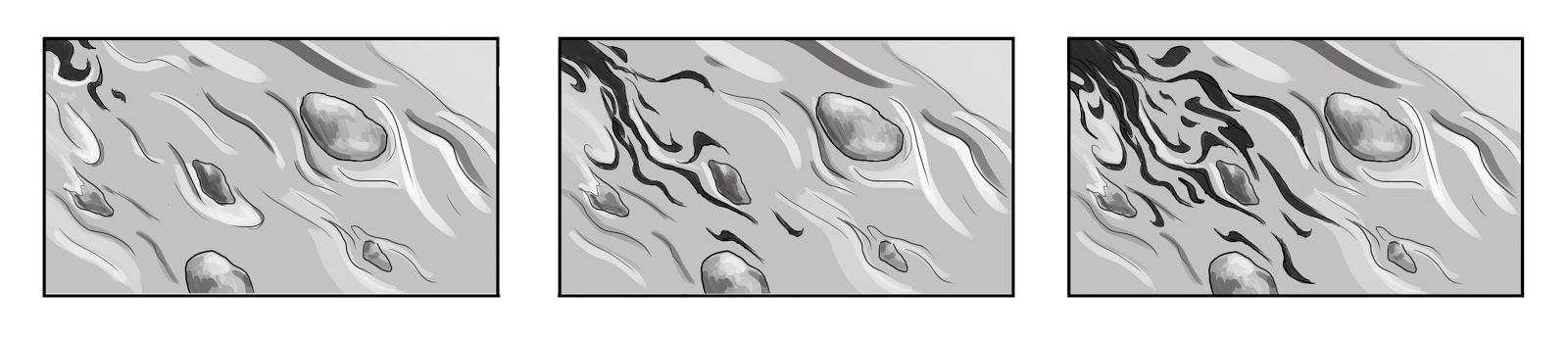
Final Animation

This is my and Karolina's final animation. 
The requirement was a 30 second video, but we've decided to go for almost 1 minute.
It was definitely very challenging and we're happy that we've made it this far, even though we've had to cut a couple seconds from the end (it's about 17 seconds shorter than our animatic)


The work was divided as follows:
1 wave: Karolina
2 waves: Me
Vacuum cleaner: Karolina
Cortina: Me
Coffee pot: Karolina
Gun: Me
I just wanna be yours: Me
Heart, chains: Karolina
Heart, shattering: Me
Maybe I just wanna be yours: Karolina

We divided the animation in this way to give it a more seamless feel and so that we both got to basically do all kinds of elements in the animation.

Here is the non-inverted version of the animation


You may notice that the wave and beat are not in sync and that's because I forgot to put a line after each repetition of the cycle, but that's been fixed and the final version is as accurate as we could get it.

The hardest part of animating this turned out to be fitting things into certain time frames...before, if I did more frames than I'd planned I just had more frames. The gun was particularly tricky because there was very short time after the shot to "unravel" it into straight line again.

Overall I'm happy with what we've achieved. There's always room for improvement, but we've both done the best we could.


Essay: Can the animated form be categorised?

Essay: Can the animated form be categorised?

Animation is a wide term. Basically, any form of art which is moving could be considered to be animated. For a group that large, there should be a way of systematising it. In his book on the theory of animation, Understanding Animation, professor Paul Wells suggests that all animated forms can be simply sorted into two categories. Those categories are orthodox animation and abstract/experimental animation. He briefly mentions a third category – developmental animation, which should incorporate elements of both categories but does not elaborate further or mentions an example. The different characteristics of each category are neatly summarised in a diagram (1998, p.36) that shows them as exact opposites with the developmental animation balancing on a line between the two. Wells later discusses and describes the individual elements, labelled by him as the Terms and conditions of animation. (1998, p.36).

The terms for orthodox animation would be configuration, specific continuity, narrative form, evolution of content, unity of style, absence of artist and dynamics of dialogue and the terms for abstract animation would be the opposite, that is abstraction, specific non-continuity, interpretive form, evolution of materiality, multiple styles, presence of the artist and dynamics of musicality. While defining these phrases, he himself sometimes admits that not everything is as black and white as he would like and that not all animated films strictly follow these ‘rules’. The model Wells presents could work on some films, but it is flawed and going only by the terms, many animations would not be included in either category or in both categories and the developmental category is so vaguely described it might as well not be described at all.  There are, though, films that fit into those categories well. For example, Steamboat Willie (Walt Disney Animation Studios, 1928) is a good example of orthodox animation. It uses narrative form, which means that the animation is in the form of a story. Chases and conflicts between characters are very common scenarios. The story is also continuous, even though there are many different things going on it is easy to tell we are still watching the same story. Even though the figures are not people we still recognise them as characters and that means the film uses configuration. Dialogue is not used extensively, but it is replaced by sound effects that correspond to specific objects or actions. Even in the earlier films, we can already see the Disney Studios style forming. The style remains the same throughout the film, signifying both unity of style and absence of artist, as multiple artists worked on this piece, yet it looks as if done by a single person and we cannot, therefore, recognise the people who have worked on it. Abstract animation could be represented by Walter Ruttmann’s Lichtspiel Opus (Walter Ruttmann, 1921), which was the first publicly screened animation. It only consists of circles, colours, flashing and moving shapes and all of that is accompanied by music. It perfectly fits the criteria for abstract/experimental animation. There are no figures or characters, only non-figurative shapes and forms in their place. Although the animation progresses and changes, it does not have a narrative and it doesn’t follow a story. The entirety of the animation is what the artist thinks and feels, how he believes the music should be represented. Revolver by Jonas Odell (Jonas Odell, 1993) could fall in the mysterious developmental category. There are recognisable characters, the style remains the same, we could talk about continuity, considering the years hinting at the passage of time, but there is no immediate connection between the scenes themselves. The animation doesn’t seem to have much in the way of a narrative aside from what the viewers figure out by themselves. The soundtrack is a lot closer to music than dialogue most of the time and when what could be called dialogue is used, it does not make any specific sense. Although this categorization is not ideal, it certainly offers at least a basis for sorting of the animated film. It might be also interesting to consider a different way of categorising animated film, for example, the time period, it’s purpose, used medium or genre, and then there is also a cultural aspect. Animation from Europe will not be the same as animation from America or Japan as these are different cultures with different values, art styles, levels of technical advancement and historical backgrounds. While in America animation was popular for example in advertising, in Europe, a lot of animation reflected, for instance, the political situation. Either as a propaganda animation, which thrived for example in the Soviet Union after it formed, or like in other fields of art, in its abstract form as a way of protest against the current situation.
  
Wells repeatedly declares that the hyper-realist cel animation, such as the work of Disney or Warner Brothers, is the dominant form overshadowing the much more artistic experimental approaches. He agrees on that with historian William Moritz, who suggests: “Non-objective animation is without a doubt the purest and most difficult form of animation. Anyone can learn to “Muybridge” the illusion of representational life, but inventing interesting forms, shapes and colours, creating new, imaginative and expressive motions – ‘the absolute creation: the true creation as Fischinger termed it – requires the highest mental and spiritual faculties, as well as the most sensitive talents of hand.” (Moritz, 1988: 25) Cel animation is without a doubt the best known and liked form of animation as it allows fast mass production and works well for storytelling, for example for cartoons, but also because it is more suitable for a casual viewer who is merely looking for entertainment, not for any deeper meanings. Wells states that “Inevitably, the amount of cheaply produced, highly industrialised cel animation made in the USA and Japan has colonised television schedules, and perhaps, more importantly, the imaginations of viewers.” (1998, p.35) and expresses his desire to bring more attention to, in his opinion more valuable, abstract animation. Throughout the book, Wells seems to be strongly against the orthodox animation and all it has to offer. Again, agreeing with Moritz, that orthodox animation is basically pointless because everything that can be animated can also be done in live action and is, therefore, not real art, unlike experimental animation which requires higher level of skills. I personally do not see the appeal of purely abstract animation. Certainly, there are people who can appreciate it and both forms of animation have their place in the field of animated film, but the way I see it, abstract animation is meant more for its author rather than an audience. It could be speculated that orthodox animation is made for the audience and its entertainment while abstract animation, though shared with an audience, is created for the animators themselves.

To get back to the original question, certainly, the animated form can be categorised to a degree and the theory of Paul Wells could serve as a foundation for possible future categorisation systems if anyone ever attempts to create them. It may have been easier in its beginning before the technologies advanced too much and animation took on a life of its own.  Nowadays, there is so much animation being created in such a wide variety that some of it would probably fall in neither or both categories defined by Wells.
(1219 words)


Bibliography
Odell, Jonas.(1993) Revolver, Available at: https://www.youtube.com/watch?v=p2HEgnlmfss   (Date Accessed-30.11.2016)  
Ruttman, Walter.(1921) Lichtspiel Opus I, Available at: https://www.youtube.com/watch?v=FYJnZ946L1c   (Date Accessed-2.12.2016)  
Walt Disney Animation Studios.(1928) Steamboat Willie, Available at: https://www.youtube.com/watch?v=BBgghnQF6E4&spfreload=10  (Date Accessed-30.11.2016)  
Wells, Paul.(1998) Understanding Animation


Assesment 1 - Animatic

This is my and Karolina's animatic for our pixilation film. (It doesn' have a title yet but we're working on it) 

The film is about the apocalypse but told from the perspective of those who cause it, the people who die in the film are just objects that get in the way. 
With the soundtrack we were going for something creepy, dissonant, and weird. We've decided to gradually add different sounds like scratching, white noise and a heartbeat to create the right atmosphere for the film. 

Final Brief - Animatic

This is my and Karolina's animatic. We've decided to make our animation a biť longer than required. We are aware that some parts aren't timed as well as they could be and we plan on fixing that. Considering the length of the video, there probably should be more frames, but I think as a first draft it's not too bad. 


We've tried to rework the animatic. It's still not the best work we've done but it's a bit better.


Week 9 - Location drawing - Worcester museum

This week we went to draw at the Worcester museum and I was expecting there would be more stuff so I was a bit disappointed but I've managed to find some things I liked.

The first drawing is an object symbolising the phrase 'man-made'. I chose the glove making cabinet because it had both the made objects and the tools to make them so I thought it fit well. It turned out messier and less detailed than I hoped, though, so I did a second drawing of just the sewing machine. Maybe if I hadn't used charcoal it would be easier to have control over the details. 
 For the 3 man-made objects I picked things connected with war. I chose not to draw the "ornament" on the helmet and tried to focus on the reflections instead. Not really happy with this one, it looks kind of deformed. 

For the one object symbolising nature I drew this fossil. I've decided to use coloured pencils for all my nature drawings while all the man-made drawings are in black and white.

 I wanted to get a kind of sense of hierarchy so the owl is on the top with the stout underneath, but I couldn' find anything that would fit in the bottom so I drew the leaves from the bird exhibit. I don't work with coloured pencils often so I'm not very confident with them, but I enjoyed working with them.


 I did the last interior/exterior drawing on a piece of brown paper and I don't like it at all. When I was drawing it the perspective looked a lot better. I have honestly no idea how I could've thought this looked okay.

There weren't many people to draw and those who were there were moving way too much for more than just quick sketches.

I know I erase a lot so I wanted to try something I can't erase and did these bottles in ballpoint pen. 


Assessment 1- Animatic WIP

We've expanded the scenes from the storyboard to make into an animatic. 
We are also currently working out the durations of specific scenes and putting together a soundtrack to go with it. The whole film will be in black and white. The scene with snake had to be cut out because we couldn't get in contact with the owner of the snake and we didn't want to plan something we weren't sure would be possible and we wanted to cut something out to make the film shorter anyway.
The opening scene should be 3 seconds long and it will be just a single rose wilting.


The last scene of the preparations will be a death summoning ritual.


Final Brief - WIP - soundtest

Final Brief - WIP - soundtest
The first 18 seconds of the song are just music and here is a little sound test we did to see if the timing works.
Link to video
We will probably add more frames in the future and play a bit with the movement of the waves, but for now we're happy that it's in sync with the music.

Final Brief WIP

Karolina and I are animating the song I Wanna Be Yours by Arctic Monkeys. Our goal is to animate the first 1:14 of the song. In terms of movies, it could be the opening sequence of a romantic comedy as the song is about love but the lyrics are kind of ridiculous. The style of the animation is inspired by the music video for Do I Wanna Know (also by Arctic Monkeys). 
The general idea is that throughout the animation there will be a line from which all the animated objects will form. I will be animating a Ford Cortina, a shooting gun and an exploding heart.
The hardest part will be definitely getting the animation in sync with the lyrics


Here's our timing sheet (yes, it's very messy and chaotic) 
 Here's the actually important part.
 some more sketches for the formation and movement of the car and the gun

Week 7 Homework - Framing

For homework, we were supposed to pick a film and then storyboard the key points of a 15-minute sequence. I chose the movie "Constantine" because I like it and as it turns out it has some nice framing (at least in  my opinion). I did the last fight/action scene from the movie. There is a lot going on so I wasn't able to do all the frames I'd have liked to because that would take me ages and it would be way too long. These should be some of the more important frames story wise, if someone hasn't seen the movie though, they'd  probably be really confused because there's a lot of information missing.


Week 7 - Framing

We watched a scene from Alfred Hitchcock's film Rear Window and then we made a storyboard for it with focus on framing. The windows often acted as frames within frames, making it more interesting.

Week 7 - Life drawing - painting

This week we did painting with acrylics.I like acrylics because of how you can layer them, but I've never worked with them this fast so I'm not really happy with my results.

 For the first two paintings we could only use two colours + white. I was using blue and yellow, but because I very smartly only prepared one brush by the end I was working with various shades of green. 
 Here I've also attempted a bit of a background, but maybe I should've spent that time on fixing anatomical mistakes. 
 For the last two paintings we could use more colours. I've picked violet and blue for shadows, ochre for light areas and I've tried to do the midtones with some kind of reddish-pinkish accident of a colour but gave up on that plan after about three brush strokes. I thought using more colours would make it easier, but it just slowed me down.
I feel like I've had a lot more control over what I was doing. Not necessarily meaning it's better, but I was feeling a bit less stressed and my work was a lot less chaotic. I know that we don't have to draw the foot when she's sitting like this and can only focus on her back and I also know that I always get the foot wrong but I am determined to try it till I get it right. 

In general I think that I sometimes freak out too much about not having enough time and I chaotically try to get as much done as possible and then I have to go back and fix everything because I've screwed up. I've also noticed that I tend to squish her a bit, for example in the first painting. 

Week 6 Homework - Lighting and chroma keying

Week 6 Homework - Lighting and chroma keying
We did this together with Karolina. At first we had some trouble setting up the lights and getting everything to work together, but we figured it out (mostly). We wanted to play around with the lights a bit, there ended up being too much light on the green screen making it hard to key out later, but I'm sure it could've been worse. 
Here's the edited version. It's not very good, but at least now I have some experience with the software.